Years ago, when I was introducing our pursuit to two of my closest friends: an avid Irish fly fisherman and an Kouri blow-through. They witnessed a learning experience that I could only have dreamed to in my early career:
We were hunting deer in a state forest in the Oberon area of NSW, the fellas had been struggling with dialling in their stalking skills and hence had no luck on deer. I decided to slow things down, move to an area of soft ground and proceed to demonstrate what an effective stalk looks and sounds like. All throughout our adventure I had emphasized the absolute importance of the wind but being novices, they really didn’t appreciate just how integral it was. Understandable, we were all city boys/townies at the end of the day.
During our stalk, my dog buck picked up on a scent up wind of us and then we really dialled in our feet. Coming up to a small clearing we observed 2 pigs. We weren’t in a rush to shoot them and simply used it as a learning experience in concealment and watched the creatures as they went on with their excavations.
Not long into our little spy game, I felt what all hunter’s dread. A gentle change in wind that caresses the hairs on the back of my neck and drifted our scent towards the game. Just as you would imagine, the pigs wasted no time, they both froze within seconds of each other, stiffened their back and darted straight into the safety of the forest. There was no looking about to make sure, no patience given in the hopes they could continue their feed, they knew what we were and launched for cover.
When I teach students the ins and outs of NSW state forest hunting, there is nothing else I emphasize more than the wind. “the wind is everything” I am usually heard saying, an exaggeration for sure but the reason I put so much emphasis on wind direction and the ability of an animal to detect scent is because it is the only factor that can end your hunt before you even start. Sustainable hunting just isn’t sustainable of you cant keep the freezer full.
When we debriefed what happened later that day at camp, I made sure that the fellas really understood just how valuable their experience was. Here’s why:
- What they had witnessed was the unforgiving nature of scent, no perfect stalking technique or super duper digital camo could have prevented this.
- It was not a matter of proximity, though we had been lose to the pigs, they just as easily could have smelt us from 400m away. I have personally experience Red deer spook from my scent at 700m in NZ with the right anabatic winds
- Hence, if scent is not controlled, which in my opinion, is only possible my managing wind. It’s likely that all you will be undertaking is an armed bush stalk
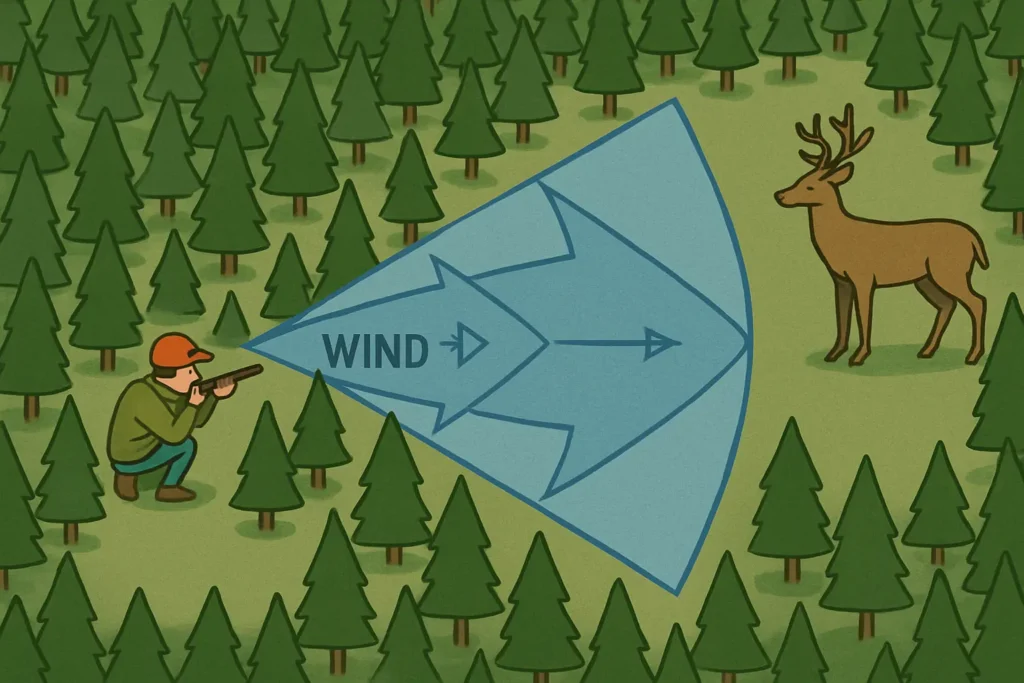
There are other ways that I mitigate my scent but, odour elimination is impossible. Some researchers say that a deer nose is 7 times more sensitive than a dogs, so that tells us enough. It’s also important to know that when your scent is dusted in a direction that as it blows away from the hunter, the detectable aroma expands into a wider area. See illustration below:


 By Luke Risk